Via Palladio 44 - Lonedo Lugo di Vicenza (VI) - ITALY
  Phone: +39 0445.860561 - +39 339.3429942 - +39 338.7481028
  Fax: +39 0445.860806 - E-mail: info@villagodi.com
The internal decoration
In his Four Books on Architecture Palladio mentions the names of the artists who worked inside the villa: Gualtiero Padovano (Padova, 1510 to about 1552), Battista Del Moro (Verona, 1514-1575) Battista Zelotti (Verona, 1526-Mantova, 1578).

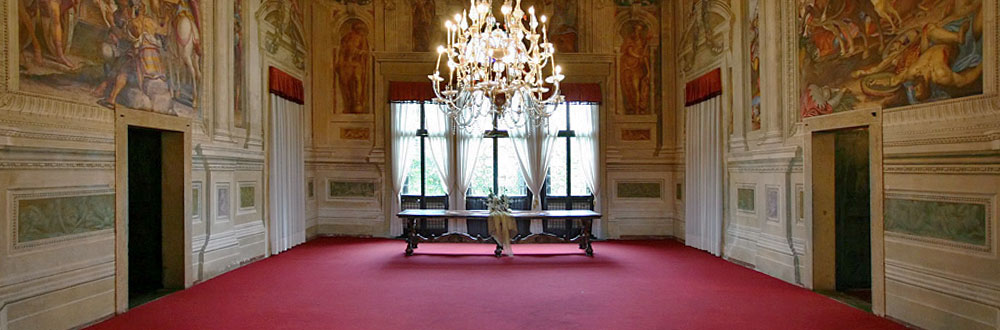
The interior of the villa is frescoed by two different schools of painters, very different in style, in their subjects and their use of colour. Facing the entrance of the villa, in the main hall and in the left wing it is possible to see the so-called classical school, that is the frescoes done by Battista del Moro and Battista Zelotti. False windows are beautifully painted with gods and Greek landscapes. Figures of men are depicted full of strength and virility and female figures recall abundance and fertility; caryatides (instead of the more common telamons) and epic tales complete the decoration. The colours of these frescoes are more tenuous, not just because they have been restored in very small areas, but because the painters who decorated this part of the building preferred using the so-called ancient rose, the sapphire light blue and the yellow-earth.

In the right wing of the villa, it is possible to see the other school called mystic, who's main painter is Gualtiero Padovano. This wing of the villa corresponds to the restored wing. The artist often paints offers to domestic firesides and satyrs; instead of caryatides he paints telamons; figures in which animals are mixed with men, can be fearful, almost ghoulish. The representation of the Greek gods would derive from the influence of the classical school (the two schools of painters involved here worked almost at the same time). The colours of these rooms are more "jazzy", which is due not only to the restoration done after World War I, but above all by the artist who used a bitter green and a stronger yellow.

During World War I the villa was occupied by the British Command. The movie, "Senso" by Luchino Visconti (1954), one of his most famous, was shot in the magnificent rooms of the villa.
The Room of Muses and Poets
Painted by Battista del Moro are big caryatides in monochrome, resting upon a base, and supported by a trabeation are painted puttos, books and musical instruments. In the panels on the walls, Poets with laurel crowns and the nine Muses appear, but only some of them can be recognized by the object or symbol they hold. In particular, in the decoration on the right side of the entrance, the Muse of Astronomy Urania can be identified. In addition, Dante, one of the most important Italian poets and one of the fathers of the Italian Language, can be seen above the fireplace. The chandelier is Venetian, 18th century.
The Room of the Olympus
Painted by Battista Zelotti. A low base supports architectural ruins that imitate white marble and red bricks; inside niches are fragments of statues. Windows and doors are decorated with false frames of fruit, flower ornaments and small pediments. At the back of the fireplace, we see some deities laying on clouds and painted with varied colours. In the centre is Jupiter and Juno, then Cybele, the goddess of architecture with a tower on the head. Ceres, the goddess of the harvest, is seen with a bunch of wheat. Mercury can be easily recognized and Cronus, the god of time, holds a sickle. Diana the goddess of hunting is seen with a bow. Facing the fireplace on the right, we can see Venus and Cupid with Bacchus the god of wine and many additional gods. In the hood of the fireplace the Fall of the God Vulcan has been painted, a subject similar to the decoration at Te Palace in Mantua, but less grotesque than the paintings of Giulio Romano.
On the left we can admire Mars, Neptune and a young girl. The line drawing behind comes from an afterthought of the author. In this room we can notice the indifference of gods for human beings: none of the gods on their cloud thrones are glancing down and taking care of mankind. Also in this room is a 18th century Venetian chandelier.
The room of Venus
Painted by Battista Zelotti is a scene of Venus, Cupid and the god Vulcan in the hood of the fireplace, where the name comes from. The golden decoration of the triclinium on which Venus sits, is very refined indeed. Also as beautiful is the contrast between the rosy skin of the goddess and snow-white drape that covers her. On the walls, long Ionic columns divide the room. One the right of the fireplace, above the door, is the allegorical painting of Justice with Pluto on the left and Cronus on the right. Looking the wall before the fireplace, we can see a big panel with Aeneas and Dido. On the right a young boy and a page come from a false door. This is a beautiful trompe l'oeil painting, a very common technique also showcased in the work of Paolo Veronese.
Above this false door is the allegorical painting of Prudence, and on the door, which leads to the next room, is the allegorical painting of Temperance. At the other wall are again figures of statues inside false niches representing Jupiter, with the symbols of the eagle, and Neptune. The chandelier is inlaid in wood and dates back to the 17th century from a Venetian galley.
The Room of Arts
Painted by Battista Zelotti, the name comes from the allegorical figures of Arts, painted above the false arches that frame the golden statues and the bronze coloured busts. On the sides of the doors, painted in sand colour, there are the allegorical paintings of Spring and, on the opposite side, Summer. Both the paintings have images of prisoners on the sides. In the false window a Greek landscape in ruins is painted and its frame is decorated by trophies with puttos, weapons, and musical instruments. The decoration is completed with niches in which painted statues of gods are frescoed: Bacchus, Apollo, Mercury and another divinities are not easy to recognize. The chandelier is a 18th century Venetian.
The Main Hall
Painted by Battista Zelotti, the walls are divided by white architectural elements, Corinthian columns and pediments. They are held together by a basement decorated with monochrome panels, in which the influence of the architect Palladio is clear. Standing in the middle of the room and facing the main door, we can notice two false windows on the right and left walls. In the first there is a landscape with the Rape of Europe (when Jupiter transforms himself into a bull and kidnaps Europe), in the second the Rape of Ganymede. According to tradition, the gentleman who sits on the border of the window is Gerolamo Godi, the owner of the villa. Looking at the loggia on the left wall we see the painting of the battle between Darius and Alexander.
On the opposite wall, the body of Darius is returned by Alexander. Both episodes are within architectural frames created to give the illusion of an external setting. In order to complete the decoration, puttos with a bunch of roses and female figures often sit on the frames that have been painted. Above the main entrance that faces the loggia the painter has depicted the allegorical scene of Hercules between Virtues and Labour, within an elaborate wooden framework. In the architrave above the main entrance there is the motto "et libera nos a malo" (and keep us away from evil) that corresponds to the sentence written outside in the loggia "stay away you, profanes".
On the three window-doors there is the Fame between two Prisoners whose meaning is linked to success obtained by following the law, a concept that comes from Roman history. The chandelier is a 18th century Venetian.
The Room of the Putto
Painted by Gualtiero Padovano, the name of the room comes from the image of the little boy sitting on the window in front of the landscape. It is decorated with Ionic columns and false niches inside which are statues of divinities. All around the cornice of the ceiling runs a frieze with other gods. During the 19th century the whole room had been painted with dark drapes to cover the nakedness then removed during the restoration.
The decoration has been completed with panels of grotesques, a particular kind of decoration that was developed immediately after the discovery of the Domus Aurea of the Emperor Nero in Rome in the 15th century. During that period, the decorations were completely buried in the ground and therefore called grottos from which the name of the style “grotesques” comes from. These decorations are often linked to alchemy or the world of farmers. The doors have been decorated with the same style. The chandelier is a Bohemia crystal and dates back to the 18th century.
The Room of Triumph
Painted by Gualtiero Padovano, the name comes from the frieze on the upper part of the room. The idea and extended shape of figures are taken from the Triumphs of Caesar, a group of works by Andrea Mantegna. The big landscape on the front wall of the fireplace is very interesting and it is possible to see the Colossus of Rhodes. In the hood of the fireplace is the fresco of Securitas, the divinity who protects the house. The decoration on the walls show telamons who are holding the trabeation and panels in monochrome.
The scene on the ceiling is very different because it was painted by Zelotti and it shows in an oval wooden frame Minerva who ties Vice with a chain. Zelotti also painted the other panels with puttos that complete the decoration of the ceiling. In this room the light holders of the torches date back to the 17th century.
The Room of Caesars
Painted by Gualtiero Padovano, whose use of colour in this room is very interesting. Corinthian columns with golden capitals divide the walls in sections opening to serene landscapes, always in relation with the real nature around the villa. In these beautiful landscapes of big blue skies, mountains and rivers, the presence of man is suggested by small coloured figures or by some simple architectural elements. The room's name comes from the busts of the Emperors, sculpted realistically above the doors and the fireplace. The series of "busts" start from the iconographic motive of the Roman Emperors, often used in the decorations of villas. Usually, the succession of Emperors derives from the "De vita duodecim Cesarum libri VIII" by Suetonius. Since the choice of the Emperors were linked to the intention of the owner to elaborate himself, it was possible that the Caesars not found in the list of the Latin writers, were painted. It happened sometimes that the owner and commissioner of the villa held himself as a descendant of one of the Roman Emperors' and therefore added his own famous origins changing the original series.
The Room of Sacrifices
Painted by Gualtiero Padovano, the Doric columns hold a continuous trabeation and in the spaces between them are landscapes and niches that imitate rusticated stones with statues of divinities. The name of the room comes from the two scenes above the doors that show Roman sacrifices painted in monochrome.
The loggia
Painted by Gualtiero Padovano. The decoration is linked to the architectural structure of the loggia. In the ceiling there is Mercury and Spring. According to tradition, the Valley that embraces the villa can be recognized in the landscapes painted on the walls. In the arches above the entrance to the rooms there are grotesques that show the Vestal of Abundance who carries hoops of fruits and a snake symbol of intelligence that keeps away satyrs, the symbol of evil. In the two false doors there are two characters, a country woman with a spindle and a farmer with a hoop full of agricultural products. It is important to remember that worms of silk were often cultivated in the kitchen gardens next to villas and that the production of fabrics was a mean of nourishment for the commissioners of villas. Also water is an element necessary to the life of the villa and a river that flowed not far from the villa is the subject of the landscapes painted in the loggia. Above the main entrance there is the figure of Securitas who protects the family. In the architrave the sentence is sculpted "procul este profani" which means "stay away you profanes", a sentence that can mean the intention of the commissioner to keep away those people who did not have the capacity to understand the program of decoration chosen for his villa.
Informations
Fill the form for more informations or contact us with:

Phone
0445.860561
+39 339.3429942
+39 338.7481028

Fax
+39 0445.860806

E-mail
info@villagodi.com
Name Surmane
City State
E-Mail * Phone
Request
 
Sala Villa Godi Malinverni
Sala di Venere Villa Godi Malinverni
Room of Venus
Salone centrale Villa Godi Malinverni
Main Hall
Sala dell'Olimpo
Room of Olympus
Sala delle Stagioni
Sala delle Stagioni
Sala delle Muse e dei Poeti
Room of Muses and Poets
Sala delle Arti
Room of Arts
Sala del Putto
Room of the Putto
Sala dei Trionfi
Room of Triumph
Sala dei Sacrifici
Room of Sacrifices
Sala dell'Arazzo
Sala dell'Arazzo
Sala dei Mobili
Sala dei Mobili
Sala degli Specchi
Sala degli Specchi
Cucina
Cucina
Details
Villa Malinverni Affresco Villa Malinverni Affresco

Visits to Villa

From November to March
Tuesday, Saturday, Sunday and Holidays
from 2:00 pm to 6:00 pm

From June to September
Tuesday, Saturday, Sunday and Holidays
from 3:00 pm to 7:00 pm

It is possible to book group visits also in different days
banquets | conference | restaurant | history | rooms | museum | park | virtual visit | location | link
©2008 Villa Godi Malinverni