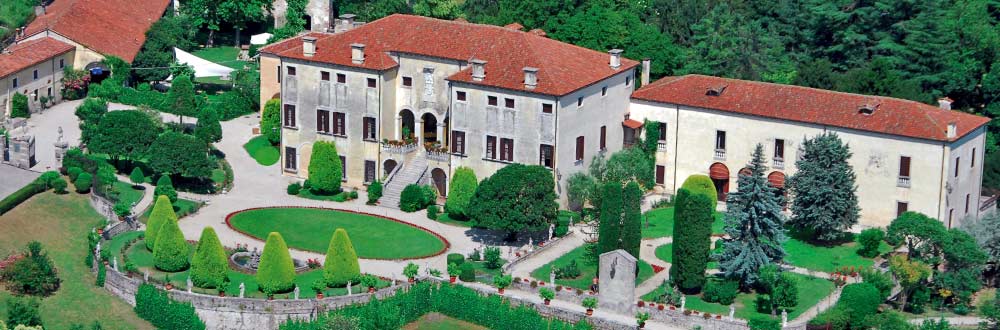
Villa Godi Malinverni: the first villa realized by Palladio |
| Villa Godi Malinverni belongs to the rich artistic patrimony of Venetian Villas. Andrea Palladio built the villa in 1542 while Gianbattista Zelotti, Battista del Moro and Gualtiero Padovano adorned it with frescoes. |
Andrea
Palladio
The architect, whose real name was Andrea di Pietro della Gondola, was born in Padua in 1508 to Pietro della Gondola, a mill worker. After moving to Vicenza at a young age, Andrea took a job in the very active workshop of Pedemuro who specialized in marble cutting and sculpture. It was during this time of apprenticeship that Andrea was noticed by Giangiorgio Trissino, an aristocrat and refined intellectual of the Venetian mainland. Trissino entrusted to the young architect the restructuring of his Villa Cricoli, located just outside of Vicenza. He also decided to take Andrea to Rome for his first visit. Thanks to his knowledge of the ancient Roman ruins, which could be seen not only in Rome but also in Vicenza, Verona and Padua, and coming in contact with the works of the greatest architects of the time - such as Giulio Romano, Michele Sanmicheli, Sebastiano Serlio and Jacopo Sansovino, Andrea was able to develop his own original style that we can still admire in some of his most important operas, such as Villa Almerico, known as "La Rotonda" and Villa Barbaro in Maser, frescoed by Veronese. Also civic buildings including the beautiful "Loggia of the Captain" and the Basilica of Vicenza. In Venice we can admire his churches "Il Redentore" and "San Giorgio Maggiore".
"In Lonedo luogo del Vicentino è
la seguente fabbrica del Signor Girolamo de' Godi
posta sopra un colle di bellissima uista, &
a canto un fiume, che serve per Peschiera. Per rendere
questo sito comodo per uso di Villa vi sono stati
fatti cortili, & strade sopra uolti con non
piccola spesa. La fabbrica di mezo è per
l'habitazione del padrone e della famiglia. Le stanze
del padrone hanno il piano loro alto da terra tredici
piedi, e sono in solaro, sopra quelle ui sono i
granari, & nella parte di sotto, cioè
nell'altezza di tredici piediui sono disposte le
cantine, i luoghi da fare i vini, la cucina, &
altri luoghi simili.
La sala giunge con la sua altezza fin sotto il tetto,
&ha due ordini di finestre. Dall'uno e dall'altro
lato ui sono i cortili, & i coperti per le cose
di Villa. E' stata questa fabbrica ornata di pitture
bellissime inventione da Maser Gualtiero Padovano,
da Messer Battista del Moro Veronese, & da Messer
Battista Veneziano; perché questo gentil'huomo,
il quale è giudiciosissimo per renderla a
quella eccellenza & perfezione, che sia possibile;
non ha guardato a spesa alcuna, & ha scelto
i più singolari, & eccellenti Pittori
de' nostri tempi." Quote of Andrea Palladio from "The Four Books of Architecture", 1570 |
The Architecture
Villa Godi Malinverni is the first villa Palladio created, as quoted in his Four Books on Architecture. The client and owner of the property was Gerolamo Godi, who had it built for his son Antonio. The work was completed in 1542. The villa, which stands on the slopes of the Lonedo hill, overlooks the Astico river and features some elements of architecture typical of castles, such as "la colombaia" or dovecote, resembling a small tower, which allowed them to view and control the plain below. The central staircase was the main access leading to the noble floors and was restricted to the central arch of the loggia; similar to the medieval drawbridge and hence being able to control all the entrances to the family's private rooms. The front of the villa is set back and flanked by two bodies protruding at an angle, instead of the villa with two towers as was typical in the Veneto region during that period. The rear of the villa comes forward where here the middle section corresponds to the main hall and we find a serliana which was built later during the restoration works in 1550, replacing the original roman thermal window. The two side wings are each contain four rooms. Only the left wing composed of three arches forms part of the original design, whereas the right wing composed of five arches was added in the late 70's of the 16th century.
|
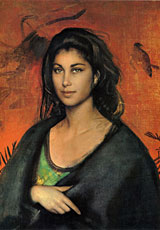 "La Strega" by Annigoni
Pietro Annigoni was an Italian painter called "the painter of queens" by the newspapers in that period. The influence of the Italian Renaissance and Realism can be seen in his style of painting as opposed to the use of Modernism and Postmodernism more commonly used during this period. Having specialized in portrait painting, he was best known for his portrait of Queen Elizabeth ll in 1955 (National Portrait Gallery, London), however he tended to concentrate more on needy people or the homeless for his subjects. From 1929 onwards, more precisely 1966 to 1988 being his most productive years, he had numerous prestigious exhibitions including several at the Royal Academy in London.
His frescoes can be found at the Abbey of Montecassino, the convent of San Marco in Florence, the Basilica of Sant'Antonio at Padua and many other locations. One of the most important operas done by him is a painting cycle for the parish church of St. Michael in Ponte Buggianese (PT). |
|
|
|